

Most LEGO collections start simple: a few sets, a handful of spare parts and one box for everything. That works surprisingly well—until the loose parts pile grows large enough that finding a specific element starts interrupting the build itself.
There is no single sorting method that works for everyone. LEGO’s own support material highlights four common approaches: sorting by color, set, size and part type. In practice, the larger a collection becomes, the more useful part-based organization tends to be, with very large collections often split down to individual part families or specific elements.
Start with how you use your collection
A collector who rebuilds official sets has different needs from a MOC builder who treats every loose element as part of a shared parts library. If your priority is rebuilding sets later, keeping parts grouped by set can make sense. If you regularly design your own models, that same system can become a barrier because the one part you need may be buried in one of dozens of set-specific containers.
Before buying drawers, bins or labels, decide what you want your storage system to optimize for: rebuilding sets quickly or finding parts quickly.
Small collections: keep it simple
With a relatively small collection, highly detailed sorting can create more work than it saves. Broad categories are usually enough.
A practical starting point might include:
- bricks,
- plates,
- tiles,
- slopes and curved elements,
- Technic parts,
- minifigure parts and accessories,
- miscellaneous specialized elements.
Brick Architect suggests an even simpler starting point: three containers for Bricks, Plates and Other. Even that basic split cuts down the number of pieces you have to search through without turning sorting into a project of its own.
Sorting by color is intuitive—but it has a limit
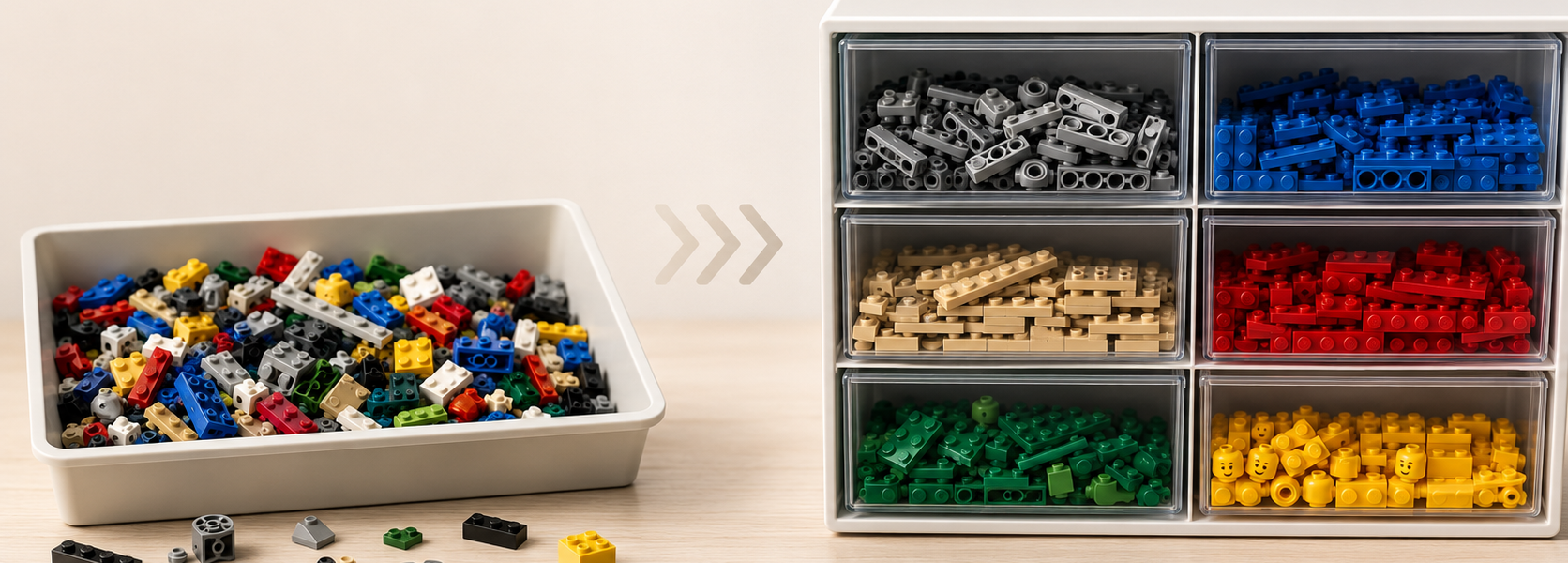
Color sorting is easy to understand. Red goes with red, black with black and white with white. For a small collection, especially one used for color-driven builds, it can work well.
The drawback appears when a single color bin contains hundreds of differently shaped pieces. Finding one black 1×2 plate among a pile of black bricks, slopes, clips and Technic connectors can be harder than finding it in a container that holds only 1×2 plates in multiple colors.
That is why growing collections often benefit from gradually shifting from color-first organization to part-type-first organization.
Medium collections: sort by part category
At some point, one big container marked “plates” becomes too crowded. That does not mean every part number needs its own drawer.
Instead, split broad categories into smaller functional groups. Plates can be divided into standard plates, modified plates, wedges and larger plates. You can do the same with hinges, clips, bars, SNOT elements, Technic connectors and other frequently used families.
The useful rule is simple: split a category when finding parts inside it becomes annoying. Let the storage system respond to a real bottleneck instead of forcing every category into the same level of detail.
Large collections: part type matters more than color
Once a collection reaches tens of thousands of elements, more precise sorting starts saving meaningful time. Brick Architect describes large collections—over 50,000 pieces in its guide—as typically being sorted by part, often with several colors stored together in the same compartment.
That does not mean every rare part deserves a dedicated drawer. High-volume, frequently used elements may get their own compartments, while unusual or low-count pieces can remain grouped in broader categories.
The goal is not perfect taxonomy. It is faster retrieval.
When sorting by set still makes sense
Keeping parts by set is a perfectly reasonable choice if you expect to rebuild those models regularly or want to preserve sets as complete units. It becomes less convenient when you want to use the entire collection as a parts library for original builds.
A hybrid system can work well: keep valuable or frequently rebuilt sets separate, while sorting the rest of the collection by part type.
Do not buy storage before you know your categories
It is easy to start with a large order of matching drawer units, only to discover later that some compartments are too small for common parts and far too large for rare ones.
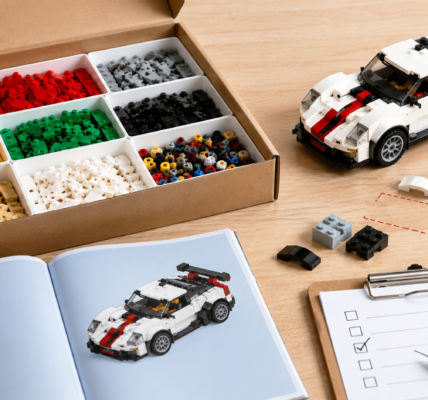
A better approach is to test the sorting structure first using temporary boxes or bags. Once you know which categories are large, small or frequently accessed, you can choose permanent storage around the collection you actually have.
Labels—and one inbox for unsorted parts
The more detailed the system becomes, the more labels help. A category name, part image or element number can speed up both finding and returning pieces.
It is also useful to keep one container for parts waiting to be sorted. That lets you finish a building session without immediately distributing dozens of pieces across multiple drawers. The only catch is that the “sort later” box needs to be emptied regularly or it becomes a second unsorted collection.
Digital inventory for larger collections
Physical storage answers “Where is this part?” A large collection eventually raises another question: “Do I own it at all?” Rebrickable lets users track complete sets as well as individual loose parts, making it possible to maintain a digital inventory alongside physical storage.
Not every builder needs a database. But if you often source pieces for MOCs or want to know what you can build from parts you already own, digital cataloging becomes much more useful.
Store bricks in conditions that will not damage them
Organization is only one part of long-term storage. LEGO recommends keeping bricks in a dry location, away from heat and direct sunlight. The company also advises against temperatures above 40°C (104°F), noting that excessive heat may contribute to brittleness or discoloration over time.
That means a convenient transparent drawer unit next to a sunny window may not be the best long-term home for a collection.
The best system is the one you will keep using
You do not need to jump from one mixed bin to thousands of individually labeled compartments. A practical system usually evolves in stages: one bin → broad categories → part families → dedicated storage for high-volume parts.
If you can find a part quickly and put it back without turning cleanup into a second hobby, your system is doing its job. When one category becomes frustrating, split that category—not the entire collection.