
LEGO Natural History Museum Is Retiring Soon — But Should You Buy It Now?

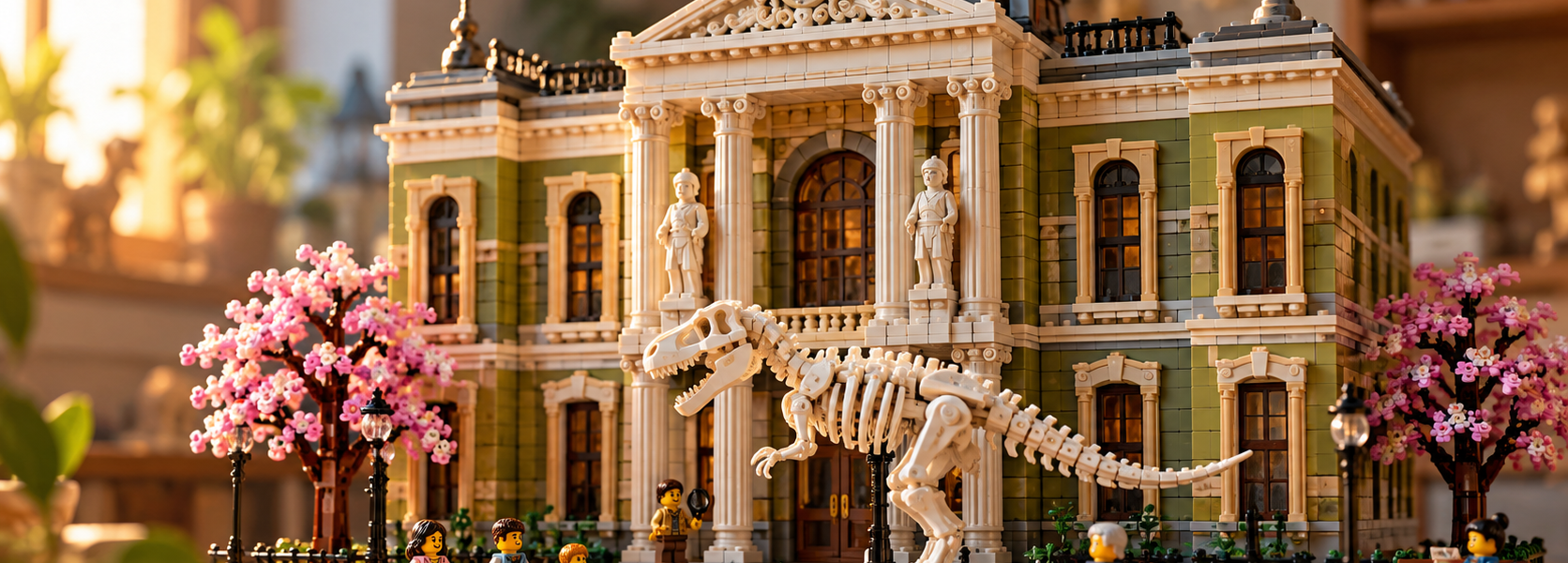
LEGO Icons 10326 Natural History Museum has moved into the last-chance stage of its retail life. The set appears on LEGO’s US “Last Chance to Buy” page and is still listed at $299.99 on LEGO.com.
For Modular Buildings collectors, that can create an immediate sense of urgency. Once a set leaves regular retail, sealed copies gradually become dependent on remaining store inventory and the secondary market. But “retiring soon” is not the same thing as “buy at full price today.”
The more useful question is not whether 10326 is approaching retirement. LEGO’s own store positioning confirms that it is. The question is whether the current price, condition and seller make a purchase worthwhile right now.
What LEGO officially confirms about 10326
LEGO lists Natural History Museum 10326 at $299.99 in the United States. The official product page specifies 4,014 pieces and 7 minifigures, and the set remains available to order at the time of writing.
More importantly for this article, Natural History Museum also appears on LEGO’s official US “Last Chance to Buy” page. That is a stronger and more useful signal than a third-party retirement forecast because it comes directly from the manufacturer.
What LEGO does not provide there is an exact guaranteed final sales date. That matters, because retirement trackers can disagree on timing. For that reason, this article treats “retiring soon” as a confirmed status, not as a precise countdown.
Retirement status can distort the buying decision
Collectors often react to retirement labels as if the next step must be a price increase. In reality, several things can happen first. Retailers may discount remaining stock. Secondary-market sellers may still have plenty of sealed inventory. Shipping costs can erase an apparent bargain. And a set that looks scarce in one region may still be easy to find elsewhere.
That is why the $299.99 LEGO price should be treated as a benchmark, not automatically as the best available deal.
BrickEconomy currently lists the set’s average new-sealed market value at roughly $320, while also showing offers clustered around the low-$300 range. Those figures change over time and should not be treated as a guaranteed transaction price, but they illustrate how close the secondary market can still be to retail while a set remains available.
Buying sealed and buying to build are two different decisions
If your goal is to build the museum and add it to a Modular Buildings street, a complete used copy can make more sense than paying a premium for an untouched box. In that case, the practical questions are completeness, condition and shipping cost.
For a used copy, check:
- whether all elements and minifigures are present,
- the condition of large plates, façade elements and light-colored parts,
- whether instructions are included if that matters to you,
- whether the set has been exposed to direct sunlight or heavy dust,
- and whether shipping a 4,014-piece set makes the final price less attractive.
If you want a sealed collector copy, box condition and storage history matter more. The key point is that “retiring soon” should not automatically justify a large premium.
Does retirement guarantee a higher price?
No. Retirement ends the steady supply from LEGO and major retailers, but future pricing still depends on demand, the amount of sealed inventory held by resellers, the popularity of the model and the broader collector market.
Third-party valuation sites often publish growth forecasts for retired sets, but those are models rather than guarantees. BrickEconomy, for example, currently projects future appreciation for 10326 after retirement. That can be useful as market context, but it should not be read as a promise of return.
For collectors, the more dependable reason to buy is simple: you actually want the set. If Natural History Museum is missing from your Modular Buildings lineup, retirement is a reason to start watching availability more closely. It is not proof that any price is acceptable.
When buying now makes sense
Buying before retirement makes the most sense if you know you want 10326 and would rather avoid relying entirely on the secondary market later. At this stage, the practical strategy is to compare LEGO’s $299.99 price with reputable retailers and secondary-market sellers, then factor in shipping, taxes and condition.
For a builder, the best value may be a complete used set. For a sealed-box collector, paying a little more for a clean copy from a trusted seller may be reasonable. Those are different use cases, and retirement does not erase that distinction.
Bottom line: treat “retiring soon” as a research trigger, not a panic button
LEGO 10326 Natural History Museum is officially in the last-chance phase, so collectors who want the set should pay attention. But that status alone does not make the current LEGO.com price the obvious best buy.
The smarter move is to compare current retail and secondary-market prices, decide whether you need a sealed or buildable copy, and buy when the combination of price, condition and seller makes sense. Retirement creates a deadline of sorts, but it does not remove the need to shop carefully.