
LDraw Nova Shows How AI Could Design Buildable LEGO Models — and Where It Still Fails

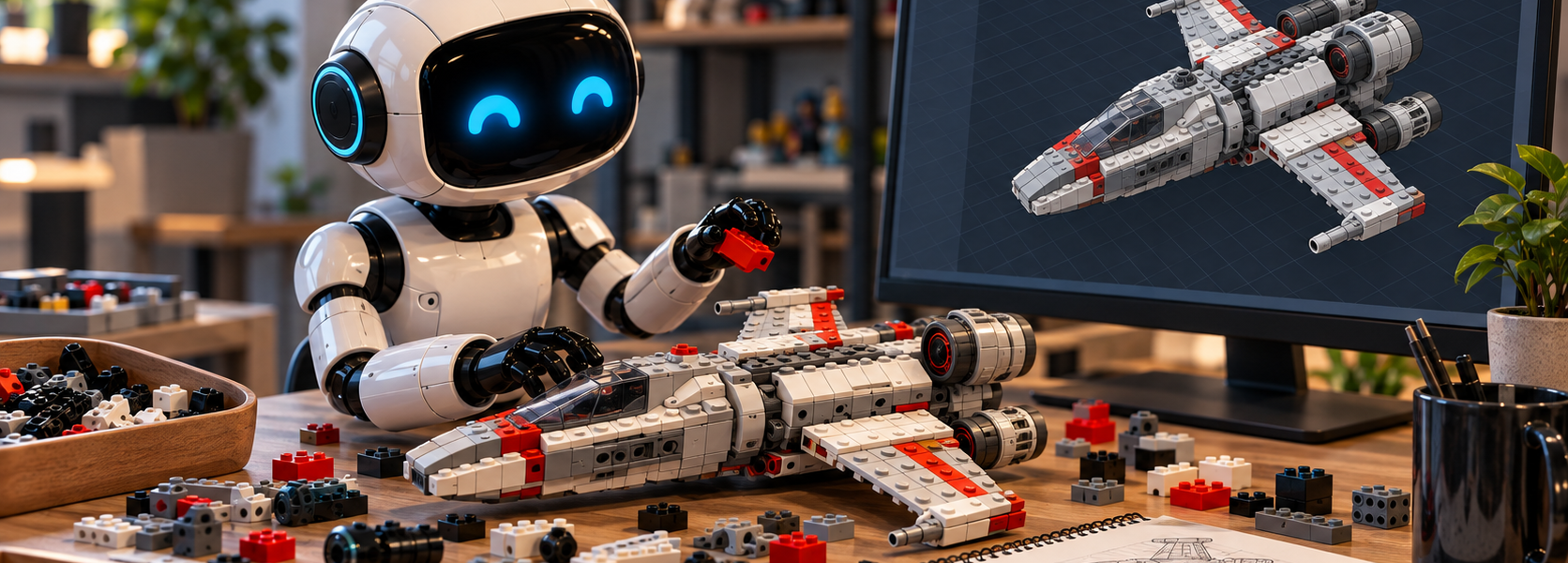
LDraw Nova points to a more consequential use of generative AI in the LEGO building ecosystem than image generation. Rather than creating a convincing-looking picture of a brick-built object, the project gives an AI agent access to the LDraw ecosystem so it can work with real digital parts, generate structured model files, render its results, inspect them, and revise the design.
That difference matters. A generated image can ignore part geometry, legal connections, collisions, and construction logic. An LDraw model, by contrast, is made from named parts placed in three-dimensional space. It can be opened, inspected, edited, and passed into an established digital-building workflow.
But that still leaves the hardest question unanswered: can the model actually be built?
What LDraw Nova actually is
LDraw Nova is an open-source project designed around AI agents that build models in the LDraw format. The repository describes a workflow in which the user provides a concept, the agent consults instructions and tooling, plans the build, searches for parts and examples, creates the model, renders it, reviews the result, and iterates.
The output can include LDraw source, a rendered 3D model, GLB files for downstream workflows such as Blender, and logs of the agent’s work. In other words, this is not a one-shot image generator. The agent is operating on a structured digital model.
Why LDraw changes the problem
LDraw is a long-established community CAD standard for virtual brick models. Its text-based format describes part placement, orientation, color, and references to specific elements. That gives an AI system a formal construction language rather than a purely visual target.
This is one of the most important distinctions between LDraw Nova and generative image tools. The system is not asked to invent a brick-like picture from pixels. It has to compose a model from a defined library of parts and transformations.
The scale of that library is significant. LDraw.org reported 17,164 unique shapes or patterned parts in its September 2026 library update. For an AI agent, that means both opportunity and difficulty: there are thousands of potentially relevant pieces, but choosing the correct one for a specific geometry or connection is a non-trivial search problem.
How the agent creates a model
One of the more interesting technical choices in LDraw Nova is that the agent is not expected to manually write every coordinate and transformation directly. The project’s author notes that language models tend to perform better when they write code that handles the geometry for them.
The process can therefore be summarized as: prompt → plan → generator code → LDraw model → render → review → revision.
The toolset also includes capabilities for part and submodel search, rendering, collision detection, and gap detection. This gives the agent a feedback loop rather than forcing it to accept the first generated result.
A clean CAD file is not the same as a buildable model
This is where the distinction between digital validity and physical design becomes important. A model can avoid obvious collisions and still be structurally weak. It can use connections that are geometrically plausible but awkward to assemble. It can be unstable when lifted, top-heavy under gravity, or dependent on an impossible building sequence.
Technic-style mechanisms add another layer of complexity. Axles, friction, backlash, load paths, gearing, and moving assemblies are not captured by visual appearance alone.
The LDraw Nova repository is explicit about the current limitations. Earlier agent experiments produced interesting results, but not models that could simply be treated as correct. The current system remains experimental rather than a guaranteed physical-design engine.
What LDraw Nova can check today
The project already has tools for detecting collisions and gaps, searching for parts, rendering models, and iterating based on the rendered output. That is a meaningful step beyond generating a static image.
It is not, however, a full physics or assembly simulator. The author also notes that larger, correct models are expensive to generate, the process can be slow, and some categories remain difficult — including more advanced spacecraft, mechanisms, and models recreated from instructions.
Those limitations are important because they define where human builders still add the most value: judging structural integrity, construction order, part stress, playability, and the design compromises that make a MOC satisfying to build rather than merely convincing on screen.
Will AI replace MOC designers?
That is not the most useful way to frame the current technology. A more realistic near-term role is AI as a design assistant.
An agent could generate multiple structural options, search a large part library, sketch subassemblies, or produce an initial CAD concept that a human builder then refines. For experienced creators, this could reduce time spent on repetitive exploration without removing the need for judgment.
The most valuable workflow may end up being collaborative: the agent proposes, the builder evaluates, and physical testing closes the loop.
Why this matters beyond a single experiment
For years, AI-and-LEGO discussions have often focused on images that look impressive but fall apart under scrutiny because the depicted parts do not exist or the connections make no sense. LDraw Nova moves the discussion to a deeper layer: structured model generation.
That does not make it an autonomous MOC designer yet. But it shows what changes when an AI agent works inside a real digital-building standard with a defined parts library, geometry, renders, and validation tools.
If future systems become better at structural reasoning, assembly order, mechanics, and physical validation, the line between generating a model and actually designing one will become increasingly difficult to draw. For now, LDraw Nova is best understood as an experimental but credible step toward AI-assisted brick CAD — not a replacement for builders, but a new tool for exploring how they might work.